If you’ve ever stood near the back of a commercial air conditioning unit on a hot summer day and felt that blast of warm, moist air, you’ve encountered a condenser doing its job. As a condenser supplier, I spend most days talking to engineers, facility managers, and HVAC technicians who know the basics—condensers turn hot, pressurized refrigerant vapor into liquid—but get hung up on one specific, critical number: the heat transfer coefficient. It’s not just a random metric on a spec sheet; it’s the difference between a unit that runs efficiently in 95°F weather and one that struggles to keep a warehouse cool on a humid day. Let’s break this down like I would when I’m walking a customer through their next project, no overly jargon-heavy lectures, just the real-world context that matters. Condenser
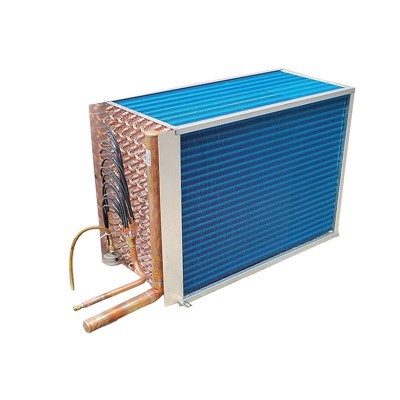
First, let’s cut through the confusion: the heat transfer coefficient (almost always shortened to U-value when we’re talking about condensers) isn’t a single, fixed number. A lot of people new to the industry think it’s a constant you can pull from a table, but that’s not how heat transfer works. When refrigerant vapor condenses inside a condenser, it’s giving up its latent heat (the heat that changes it from gas to liquid) to the ambient air or water flowing over the condenser tubes. The U-value is a measure of how easily that heat moves across that path—from the refrigerant inside the tube, through the tube wall, through any dirt or corrosion on the outside, and into the cooling medium (air or water) on the other side. Every step along that chain impacts the U-value, and that’s why two identical-looking condensers can perform totally different in the field.
Let’s start with what drives the U-value inside the condenser tubes. If we’re talking about an air-cooled condenser (the most common for light commercial and residential HVAC), the inside of the tubes carries hot refrigerant at roughly 100 to 120°F, depending on the system’s pressure. The heat moves from the vapor to the tube wall via convection—think of that as the “speed” at which the refrigerant gives up heat to the metal. Then there’s the resistance from the tube wall itself: copper is the standard here because it’s highly conductive, but even thin copper has a tiny amount of resistance. The biggest variable, though, is the outside of the tubes. For air-cooled units, that’s where the ambient air flows over the fins, and air has a much lower heat capacity than water. If air is moving slowly across the fins, or if the fins are blocked with dust, pollen, or bird droppings, that outer convection resistance spikes, and the overall U-value drops fast. For water-cooled condensers, the outside is a water jacket or a water stream—water transfers heat way better than air, so water-cooled units typically have higher U-values, but they’re also prone to scaling from hard water, which adds its own resistance over time.
I see this play out all the time with customers who come to me looking to upgrade their existing systems. Last quarter, a restaurant chain in the Midwest reached out because their old walk-in cooler condenser was running 15°F warmer than it should in the summer. Their service tech had cleaned the fins and checked the refrigerant charge, but the performance still didn’t match the spec sheet. When I pulled the original spec for that old unit, its U-value was listed at 1200 W/m²·K, but we tested the in-field U-value at 750 W/m²·K. The gap? The old condenser had thinner tubes and smoother fins that got dirty quickly, plus the system’s fan only moved air at 80% of the rated speed. When we swapped it for our line of condensers with enhanced fins (that trap less dust and are easier to clean) and a variable-speed fan calibrated to maintain consistent air flow, the U-value jumped to 1150 W/m²·K, and the system’s operating temperature dropped right back to its designed level. That’s the real value of understanding U-value: it’s not just a number to check off a spec—it’s a predictor of how your system will perform when it’s actually installed and running.
Another key point: U-value changes over time, and that’s something most end users don’t plan for. I’ve had customers tell me they only service their condensers once a year, but even minor fouling—like a thin layer of dust on the fins, or a tiny bit of oxidation on the tubes—can reduce U-value by 10 to 20% in just six months. It’s not just about efficiency, either. When the U-value drops, the refrigerant has to run at a higher pressure to get rid of the same amount of heat, which raises electricity costs and shortens the compressor’s lifespan. We’ve had data from our own test facilities that show a 10% drop in U-value leads to an 8 to 12% increase in annual energy use for typical air-cooled HVAC systems. That adds up fast over the life of a system—over 10 years, a building could pay thousands extra in utility bills for a condenser with a slightly lower U-value upfront, even if it’s cheaper to buy initially.
There’s a common misconception that a higher U-value is always the best, but that’s not the whole story. U-value is tied to the size and cost of the condenser, too. A condenser with a very high U-value might use enhanced tube surfaces or advanced fin designs to maximize heat transfer, but those add to the upfront cost. For applications where space is limited—like a rooftop unit in a dense urban area—paying a bit more for a higher U-value condenser that’s smaller is worth it, because you don’t have room for a larger unit. But for a warehouse with lots of space to spare, a slightly lower U-value unit that’s cheaper to buy and maintain might be the better long-term investment, as long as it’s sized correctly for the load. The trick is matching the U-value to your specific operating conditions, not just chasing the highest number on paper.
Let’s also talk about how we test U-value, because that’s where a lot of suppliers cut corners. At our in-house testing lab, we follow ASHRAE Standard 23, which is the industry standard for testing air-cooled and water-cooled refrigerant condensers. That means we test units at a range of operating temperatures and air flow rates, not just the ideal 95°F dry bulb temperature that spec sheets often use. A condenser that has a great U-value at 70°F ambient might see a 25% drop in U-value when the outside temperature hits 105°F, which is the kind of real-world condition you deal with most summers. When a customer gets a quote from us, we always provide U-value data at multiple ambient temperatures, not just the standard one, so they can see how the unit will perform when it’s working hardest. I’ve seen too many customers get burned by suppliers that only test at perfect conditions, leading to underperforming systems in the field.
Another factor that affects U-value is the condenser’s operating pressure and refrigerant type. Modern systems use lower-GWP refrigerants like R-32 or R-454B, which have different thermodynamic properties than older refrigerants like R-22. That means the heat transfer rate inside the tubes changes, so the U-value for a condenser designed for R-32 will be different than one designed for R-22. We adjust our tube sizes, fin spacing, and surface treatments to optimize U-value for each refrigerant, because even a small adjustment can make a big difference in efficiency for the end user. For example, condensers for R-32 can have slightly higher U-values because R-32 has better heat transfer characteristics at typical operating pressures, so we can design those units to be a bit more compact without sacrificing performance.
Now, let’s get back to why this matters for you, whether you’re designing a new HVAC system, upgrading an old one, or managing maintenance for a building. If you’re working on a project right now, don’t just look at the “U-value = X W/m²·K” line on a spec sheet. Ask: is this number tested at real operating conditions? How does the unit hold up under fouling, which is inevitable in the field? How does the U-value change when the ambient temperature is higher or lower than the standard test point? As a condenser supplier, we build our units to deliver consistent, real-world U-values, not just numbers that look good on paper. That’s why our test data includes results from 50°F to 110°F ambient temperatures, because we know your system will have to perform across that range throughout the year.
If you’re dealing with a system that’s underperforming right now, checking the U-value is a good first step. We can help you test your current condenser’s in-field U-value, compare it to its rated value, and figure out if the issue is fouling, low air flow, or just an undersized condenser. For example, last year we worked with a hospital in Arizona that was having trouble keeping operating rooms at 72°F during summer heatwaves. Their existing condenser had a rated U-value of 1100 W/m²·K, but our field test found it was down to 600 W/m²·K because of a clogged filter and a fan that was running too slow. We recommended cleaning the fins, replacing the filter, and adjusting the fan speed, which brought the U-value back up to 1020 W/m²·K, and the hospital hasn’t had any temperature issues since. In cases where the condenser is too far gone, we can design a replacement that matches the hospital’s load, with a U-value optimized for the 115°F ambient temperatures they deal with.
At the end of the day, the heat transfer coefficient isn’t just a technical term—it’s a metric that directly impacts your energy bills, equipment lifespan, and comfort. Too often, the focus is on upfront cost, but the U-value is a key part of long-term value. A condenser with a strong, field-proven U-value will run more efficiently, need less maintenance, and last longer than a cheaper unit with a inflated spec U-value that drops off as soon as it’s installed.
If you’re working on a project and want to talk through your specific needs, whether you’re sizing a new system, troubleshooting an underperforming condenser, or just have questions about how U-value applies to your application, we’re here to help. We work with HVAC engineers, facility managers, and contractors across industries, so we’ve seen almost every scenario and can provide tailored solutions that balance performance, cost, and reliability. Don’t hesitate to reach out to discuss your condenser needs and find the right U-value match for your system.
Finned Tube References
ASHRAE Standard 23: Methods of Testing for Rating Refrigerant Condensers
Incropera, F. P., & DeWitt, D. P. (2002). Fundamentals of Heat and Mass Transfer. John Wiley & Sons
Govan, J. A., et al. (2010). “Heat Transfer Coefficients in Condensers for HVAC&R Applications.” International Journal of Refrigeration
Xiangshui Derkang Refrigeration Equipment Co., Ltd.
As one of the most professional condenser manufacturers in China, we’re featured by quality products and low price. If you’re going to buy discount condenser, welcome to get quotation from our factory. We also accept customized orders.
Address: No. 2, Xiaojian Town Entrepreneurship Park, Xiangshui County
E-mail: 505745223@qq.com
WebSite: https://www.xsderk.com/
